
1
Categories chosen once
Many authors pick categories at upload and never revisit them, even after the book has grown into a different readership or a sharper sub-genre.
I help authors make their books easier to find on Amazon and beyond. That means sharper categories, keywords that match how readers search, metadata that speaks their language, a launch plan with real dates, and advertising that is measured and adjusted rather than guessed at. Every recommendation is written down, with the reasoning, so you can act on it at your own pace.
 Add your photo: delight-portrait-hero.jpg
Most books that struggle on Amazon are well written. The gap is usually in the details that decide who sees the cover in the first place, and those details are rarely explained to the author.
Many authors pick categories at upload and never revisit them, even after the book has grown into a different readership or a sharper sub-genre.
Keywords often describe the book in the author's own language. Readers search with different words, and that gap quietly costs visibility every day.
A description can summarise the story perfectly and still give a browsing reader no reason to click Buy within the first few seconds.
Every service builds on discoverability. Start with one, or combine several depending on your goals and budget.
Categories, keywords, metadata and Amazon Ads, rebuilt around the readers your book is written for.
Timelines, ARC coordination, pre-orders and promotions planned backward from release day.
Cover feedback, blurb writing and the author presence that turns a click into a sale.
Podcasts, blogs, reviewers and press that reach readers outside the Amazon search bar.
Wide distribution, audiobooks, library channels and direct sales, chosen deliberately.
You always know what happens next. Each stage ends with a written summary, and you decide what moves forward.
Answer six quick questions about your listing and launch. You receive a score out of 18, a plain-language reading of where you stand, and your single biggest opportunity.
Three clear options, from a focused audit to a long-term partnership. Every project begins with a quote written for your book, your goals and your budget.
A full, prioritised review of your listing, for hands-on authors who want a clear plan to carry out.
View detailsAudit, metadata rebuild and a full 8 to 12 week launch plan, for debut authors and books with a release date.
View detailsDiscoverability, launch, content, PR and distribution together, for series authors and established indies.
View detailsAuthors who have worked with me often recommend me to colleagues. If you know an author who would benefit, you can send an introduction in a few minutes.
Send your book details and I will reply by email with the biggest opportunities I can see. There is no obligation, and no call is required.
I am Delight Maxwell, a book discoverability strategist based in New York. I work with authors around the world, mostly on books sold through Amazon, and I offer wider marketing support where a book needs it.
Add your photo: delight-portrait-hero.jpgA well-written book can disappear on a platform built on categories, search and comparison. I became interested in the mechanics that decide who sees a cover, and in how much of that mechanism is simply never explained to authors.
My approach is to show the reasoning behind every recommendation. You will see which categories I suggest and why, which keywords I would test, what evidence supports them and what I would do if the evidence turned out to be wrong. Nothing important is kept in my head.
I do not promise sales, bestseller status, reviews or rankings, because no honest professional can control those things. What I can offer is careful analysis, a plan you understand, and steady, measured work that you can check at any point.
Authors at different stages, in many genres, sharing one goal: readers who find the right book.
Preparing a first release and wanting the listing, categories and launch right from the start, before the window closes.
Building a readership across books, and making sure each title leads clearly to the next one in the series.
Giving older titles a fresh look at categories, keywords, blurbs and covers, often without rewriting a word of the book.
Positioning practical or personal books for the readers who need them most, with a clear problem and a clear promise.
Send a message and tell me where you are. I will reply by email, and calls are never required.
Getting a book found is where I started, and it is still the foundation of everything I do. A book that is easy to find still needs a strong launch, compelling packaging and a plan to reach readers beyond Amazon. Here is how the pieces fit together, and how I can help with as much or as little as you actually need.
Each section below explains what the service covers, how the work is done, what you receive and what is included. Use the buttons to jump straight to the one you need.
Categories, keywords, metadata, ads, A+ Content and full KDP optimisation.
Full launch timelines, ARC coordination, pre-order strategy and promo site bookings.
Cover feedback, blurb writing, website structure, and email and social direction.
Press coverage, podcast pitching and book blogger outreach beyond the Amazon algorithm.
Wide distribution setup, audiobook strategy and direct sales for a resilient business.
This is the foundation. If readers who are actively searching for a book like yours cannot find it, the rest of your marketing has to work much harder to compensate. This is where I start with every author, and it is where every engagement begins.
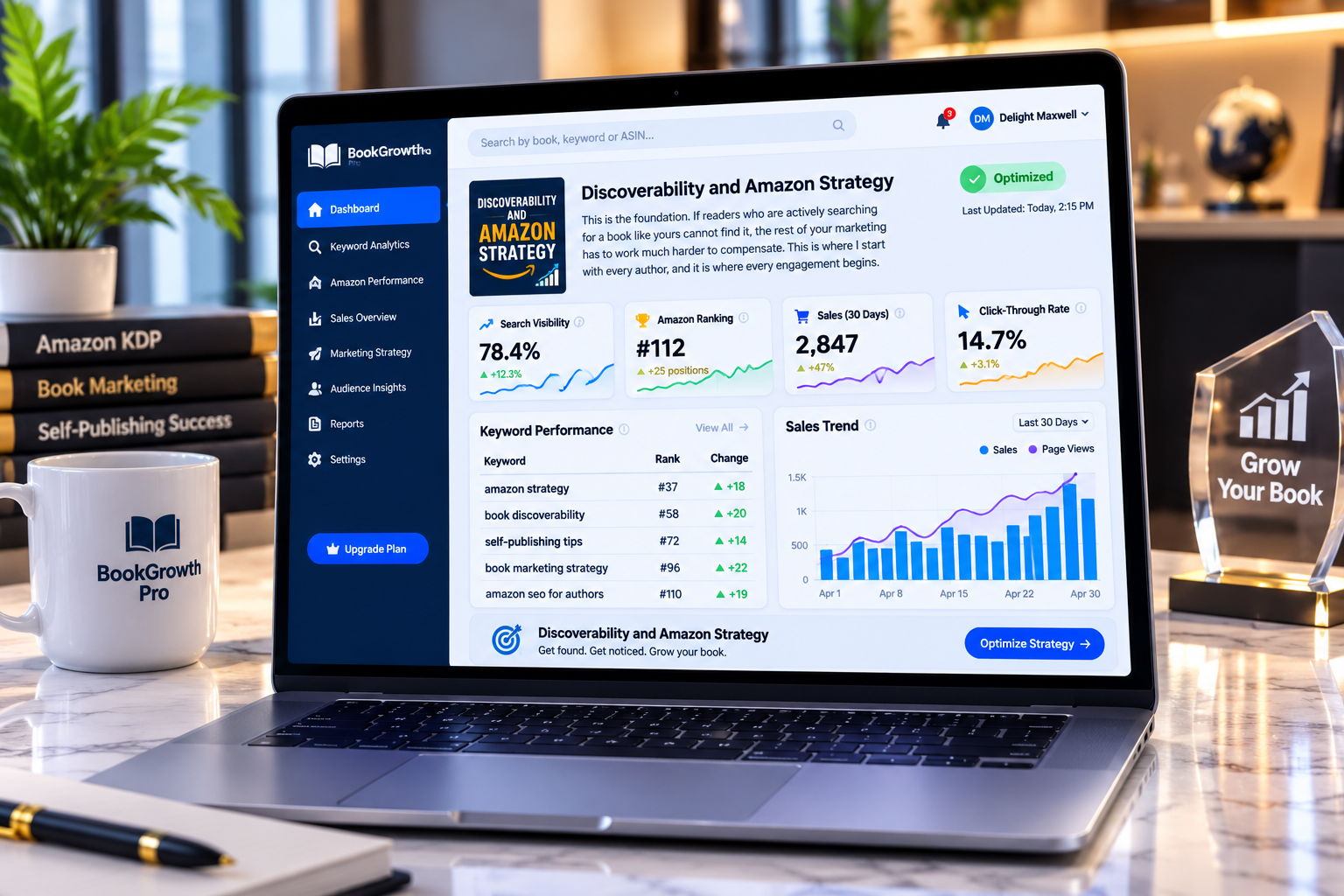
Most indie books are set up with the wrong categories, weak or missing keywords, and metadata that does not match how readers actually search. The result is an invisible book. Your book may be exactly what a reader wants, but if the metadata is not speaking that reader's language, Amazon has no reliable way to connect the two of you.
Amazon hosts an enormous number of titles competing for the same attention. A listing that is not structured to compete slips down the results, not because the book is weak, but because the system cannot see it clearly.
I audit and rebuild your Amazon presence from the ground up. That covers every category, every keyword slot, every backend metadata field, your A+ Content and your advertising strategy. Each element is set up to work with the others, as one system.
Everything is grounded in research into how readers in your specific genre browse and search. Nothing is left on default settings, and nothing is copied from a generic playbook. Each choice is made with your book in mind and can be explained.
I use keyword research tools to see the phrases readers type and how strongly they are used, and I cross-check those findings against manual review of competing titles and Amazon's own search suggestions. I look at what is ranking, why it is ranking, and which gaps your book is well placed to fill.
There is no guesswork and no "let us try this and see what happens". Every recommendation has evidence behind it and reasoning that I can explain to you in plain English.
A book positioned to be found by the readers most likely to buy it. Stronger category placement, better keyword visibility, and advertising that points readers to a listing that works. The foundation makes every other marketing effort you make more effective.
You also receive the strategy documents, keyword lists and research files as PDF, DOCX and editable spreadsheets. They are yours to keep, whether or not we work together again.
Every discoverability engagement includes these core deliverables, tailored to your book and genre.
Your launch window is when the algorithm pays the most attention to a new title. A coordinated launch can set the course for months, sometimes years, of sales. A weak launch can bury a book that might otherwise have done well.

Many indie authors publish first and only start thinking about marketing afterwards. By the time things are organised, the most useful part of the launch window has gone. The book sits in the new-release stream and starts from behind.
Others front-load excitement without a plan. A burst of sales in week one, mostly from friends and family, is followed by a sharp drop when the initial interest fades and nothing sustainable is in place.
I build a launch timeline that brings together pre-orders, advance reader copies, promo site submissions, advertising ramp-up and release-day activity. The aim is to create momentum that carries past the first week.
Every launch is planned backward from release day, usually starting eight to twelve weeks before publication. Each task has a date and an owner, and everything is written down, so nothing depends on memory.
I plan advance reader copy distribution to encourage early honest reviews, and I research promotional sites that suit your genre and budget before booking anything. Pre-order pricing and duration are chosen for your situation, not copied from a template.
Advertising is set up before launch and ramped up on release day. Newsletter swaps and cross-promotion opportunities are identified, and the whole plan is timed to build momentum through the first thirty to sixty days.
A launch that feels organised rather than chaotic. A realistic chance of reviews around release day. Sales activity in week one that supports the listing, and a clear plan for weeks two, three and four, rather than release day and hope.
Most importantly, you get a launch you can carry out without losing your sense of what comes next. Everything is broken into small tasks with deadlines.
Once readers find your book, it has to convert them. Your cover, your blurb and your author presence all shape whether a click becomes a sale, and whether that sale becomes a reader who comes back for the next book.

A book can have excellent metadata and still lose sales. The cover may not fit the expectations of its genre, the blurb may describe the book instead of selling it, or there may be no author presence to build trust with a browsing reader.
This is where authors often overspend without improving results. A beautiful cover can signal the wrong genre. A blurb can read like a summary. An elaborate email system can be abandoned after three months because it was never sustainable.
I give honest feedback on your cover. Does it match the conventions of your sub-genre? Does it read clearly at thumbnail size? Does it promise the kind of book you have written? I then write or refine your blurb with a structure built around a hook, the central conflict and the stakes.
I help you set up the author presence that supports long-term visibility without becoming a full-time job: a website, an email list and social channels, in the minimum useful form.
Cover feedback is grounded in the study of top-performing books in your sub-genre. Blurbs are built on a hook, a conflict and stakes, and then tested against how readers in your genre actually scan a listing. Romance blurbs read differently from thriller blurbs, which read differently from literary ones.
Website and email guidance is deliberately practical. The goal is to focus on what moves the needle, and to say plainly when something can be skipped.
A professional, genre-appropriate package that turns interest into purchases. A blurb that reads the way your ideal reader hopes a book will read. Clear guidance on which author platform pieces you need, and explicit permission to ignore the ones you do not.
Every piece of content, whether a blurb, a cover report or a website structure guide, is delivered as editable DOCX and PDF files that you can keep and reuse.
Readers do not only discover books through Amazon. Podcasts, blogs, press coverage and social creators all introduce books to people who would never have searched for them. This service puts your book in front of those readers, on the platforms they already trust.
Pitching press, podcasts and bloggers takes knowing who to contact, what each outlet covers, what makes a story worth their time, and how to write something they will answer. Most authors send one generic message to a long list and hear nothing back.
They often conclude that PR does not work. In reality, the pitch was never opened, or it was opened, recognised as generic and deleted within seconds.
Every campaign starts with research rather than a mailing list. I identify the podcasts your readers listen to, the bloggers they trust and the journalists who cover books like yours, and I note what each one has published recently.
Pitches are written individually and tied to a specific hook that matters to that outlet. Follow-ups are timed sensibly, and every response is tracked so the campaign can improve over time.
Before anything is sent, I look at who covers books like yours, what their audience looks like, what hooks are most likely to interest them, and how they prefer to be contacted. Outreach to social creators follows each platform's rules, with clear disclosure where it is required.
Coverage in outlets your readers really use: podcast guest appearances in front of engaged listeners, blog features and reviews that remain useful for years, and media kit assets you can reuse across your marketing. Real relationships with people who may cover your next book too.
Done well, PR builds value across your whole author career rather than producing a single burst of attention.
Amazon is not the only place readers buy books. A considered wider strategy opens new revenue streams and reduces dependence on one platform, which matters when a single algorithm change can reduce income almost overnight.

Many indie authors are exclusive to Amazon by default rather than by decision. They miss readers on other retailers, in libraries and in audio, and they have no direct channel to readers. When something changes on the platform, they have no backup and little leverage.
This is not an argument against Amazon. For many books it will remain the largest source of income. The risk lies in building an entire business on one platform you do not control.
I assess whether going wide makes sense for your book, your genre and your business goals. Not every author should go wide. For some genres and business models, a focused exclusive strategy is the better choice, and the decision should rest on evidence rather than fear or fashion.
If wide makes sense, I set up distribution through the platforms that suit your book. If it does not, I will tell you honestly and we will focus your resources where they matter most.
Every distribution choice is grounded in your genre, your series structure and your goals. Once we agree the direction, I handle the technical setup on each platform: print distribution for bookstores and libraries, wide ebook distribution, audio production and library platforms, each set up correctly the first time.
A distribution strategy that fits your book and your business, a direct sales route that captures readers and builds long-term value, and reporting that shows what is actually working across every channel.
You also get a consolidated view of sales across platforms, so decisions are based on your own numbers.
Take the Book Visibility Score first. It points to your biggest opportunity, and you decide what to do with it. Reach out after that and we can talk about what your book actually needs.
You will always know what is happening, how long each stage takes and what I need from you. Nothing begins until you have a written quote you are happy with.
About 5 to 7 business days after your intake details arrive
I review your listing, categories, keywords, metadata, cover, blurb and any existing ads, and compare them with books in your sub-genre. You receive a written report that explains each finding and ranks the changes by likely impact and effort.
At your own pace
We go through the report together, by message or, if you prefer, on an optional call. You decide the priorities, and I write up a plan with owners, dates and the reasons behind each step. Nothing moves forward until you agree it.
Typically a few weeks, depending on scope
I carry out the agreed work, whether that means listing changes, launch tasks, promotions or ad management. Each change is logged, so you can see exactly what was done, when and why.
Based on your package
We look at what was measured, what it means and what to do next. You leave with a clear summary and a recommended next step, whether or not you choose to continue with me.
Start with the essentials below. If something is missing, we can fill the gap during the audit, and I will tell you what I still need.
Communication happens by message and email, with shared documents for detailed work. Every decision is written down, so you can search for it later and nothing depends on memory or on a conversation you cannot recall.
Calls are always optional. If a call would help with a complex question, I will suggest one, but you are never required to take one. Replies to messages usually arrive within two business days.
Every engagement starts with discoverability as the foundation. The three packages below describe how far you want to go from there. Each one is quoted individually after your free audit.
These packages suit authors who want a thorough rebuild of their discoverability, launch or wider marketing. They are not for every author. Many authors need targeted help in one area, and that is often quicker, more affordable and just as useful.
Reach out first. I will look at your book, review your current setup and understand the problem you are trying to solve. Then I will tell you which level of support fits, and send a quote that is fair and realistic for your situation.
Tier 1
Best for: a complete review of your Amazon listing, with actionable recommendations you can carry out yourself or hand to me to implement.
Timeline: 5 to 7 business days from intake.
Tier 2
Best for: debut authors, books with a release date, and backlists that need a full relaunch with a launch plan and hands-on implementation.
Timeline: 8 to 12 weeks, plus the post-launch review period agreed in writing.
Tier 3
Best for: series authors and established indies who want discoverability, launch, content, PR and distribution handled as one plan, with ongoing monitoring.
Timeline: ongoing, with the length of engagement agreed in writing before work begins.
Check what each package covers. Your written quote confirms the final scope for your book.
| Feature | Audit Only | Setup and Launch | Full Service Partnership |
|---|---|---|---|
| Full Amazon listing audit | Yes | Yes | Yes |
| Written report, PDF and DOCX | Yes | Yes | Yes |
| Metadata implementation | No | Yes | Yes |
| Category and keyword setup | No | Yes | Yes |
| Launch timeline | No | 8 to 12 weeks | Yes |
| ARC strategy and coordination | No | Yes | Yes |
| Promo site research and bookings | No | Yes | Yes |
| Amazon Ads | Review only | Setup and early management | Ongoing management |
| Cover feedback | Assessment | Assessment | Full guidance |
| Blurb writing | No | No | Yes |
| PR and media outreach | No | No | Yes |
| Wide distribution setup | No | No | Yes |
| Audiobook strategy | No | No | Yes |
| Ongoing monitoring | No | Post-launch review | Monthly reports |
| Support after delivery | 30 days by email | Post-launch support, agreed in writing | Ongoing, agreed in writing |
The three packages describe full transformations. Most authors do not need that level of investment, and that is fine. Send me your book and your problem, and I will quote you for exactly what you need, with no pressure and no upselling.
Let me look at your book first. Then we can talk about what you actually need and what it would cost. No obligation, no pressure.
Response within 2 business days. Calls are never required.
I only share results with written permission. No fabricated screenshots and no inflated numbers. The feedback and case studies below are samples that show the format and depth of my work. They will be replaced with approved material as authors give permission.
Short notes that show the kind of response I hope to earn. Each one is labelled as a sample until real, approved feedback is in place.
Three detailed breakdowns showing the questions I ask, the problems an audit tends to uncover, and the reasoning behind each change. The clients named are illustrative, and no outcomes are promised.
I only add new stories with explicit written permission from the authors involved. Client privacy comes first: initials only, no personal photos, and no book covers unless a client specifically asks for them to be shown. Past clients who want their results featured are welcome to get in touch.
Many book marketers make dramatic claims with no context, because a big promise is an easy way to get a call. I do not work that way, and I want you to know what to expect before we begin.
Results depend heavily on the book itself. The best discoverability strategy cannot rescue weak writing, poor editing or a cover that misrepresents the book. My job is to make your book fully visible. Your job, and the book's, is to make a reader want to buy it.
A niche category does not behave like a large, crowded one. Comparing numbers across genres is rarely meaningful, so I judge progress against what is realistic for your specific readership.
Inflated figures might attract attention, but they do not build a career. I would rather earn your trust through careful, verifiable analysis than impress you with numbers you cannot check.
If I look at your book and believe it has fundamental issues that marketing cannot fix, I will tell you honestly before you spend money with me.
Authors who have worked with me often recommend me to colleagues. A short introduction is all it takes, and the author decides whether to get in touch.
It starts with a free look at your Amazon listing. Let us find out what is realistically possible for your writing career.
Response within 2 business days. Calls are never required.
Every genre has its own reader habits, shelf logic and cover expectations. My analysis starts with the readers, not with a template, and each genre is treated on its own terms.
Tension, pacing and sub-genre signals matter here. I look at how readers separate cosy mysteries, procedurals and psychological thrillers, and make sure your categories, keywords and blurb point to the right group.
Romance readers shop by trope and heat level as much as by genre. I help you name your tropes clearly, choose sub-categories with the right readers, and align the cover and blurb with the promise you make.
Sci-fi readers are specific. Hard science, military, space opera and cyberpunk each attract different buyers. I position your book with the readership most likely to enjoy it, and compare it with established titles in that lane.
Epic, urban, low fantasy and romantasy each have distinct browsing habits. I work on sub-genre clarity, series sequencing and keywords that match how fantasy readers search.
Parents usually search, and children usually read. I write for both audiences, with age and reading-level signals for the adult buyer and a listing that appeals to the young reader.
YA listings must speak to teenagers and to the adults who influence what they buy. I review audience framing, cover conventions and blurb tone for both.
Tone is the key signal. I help you separate gore, psychological horror and supernatural romance, so the right fans find the book and the wrong ones do not.
Quieter books need precise positioning. I help you describe the book honestly, choose comparison titles with care and avoid vague copy that hides the premise.
Period, setting and point of view all shape the reader. I look at period keywords, comparison titles and how the blurb signals the era and the emotional stakes.
Non-fiction is bought to solve a problem or answer a question. I focus on subtitle clarity, problem-led descriptions and the categories where your reader actually looks.
A personal story still needs a reason to be chosen now. I help you balance the human story with a clear hook, and position the book for readers who want that kind of account.
If your genre is not on this list, send a message. I will tell you honestly whether I can help, and what I would look at first.

Nine steps, applied to your book, produce a positioning that is specific rather than generic.
The exact words readers type, the phrasing they use and how that changes across seasons and trends.
Where comparable books sit, which categories are crowded, and where a well-positioned book has room to stand out.
Which established books to compare with, why they fit, and how the comparison shapes your listing and ads.
Phrasing that matches reader search across all seven backend keyword slots, without repeating the same idea.
What readers in your genre expect at a glance, and where your cover can match those expectations while still standing out.
A clear hook, the central conflict, the stakes and a reason to buy now, arranged to suit how your genre reads.
The timing of promotions, reviews, pre-orders and ads around release, matched to how readers in your genre buy.
Which search terms and comparison targets are likely to reach readers who will actually buy, rather than only browse.
Where your readers gather, which newsletters, podcasts and creators they trust, and how to reach them respectfully.
Tell me your genre and the readers you have in mind. I will reply by email with the first questions I would ask about your book.
Straight answers about how I work, what is included and what I cannot promise. Still unsure? Send a message.
Answer six quick questions about your listing and launch. You will receive a score out of 18, a reading of where you stand and your biggest opportunity.
The free book audit is a first look. You send your book details, I review the public listing and reply by email with the main opportunities I can see, and the package, if any, that would suit you.
There is no obligation, and no call is required. If the audit shows that nothing needs changing right now, I will say so.
Send your details and I will reply by email. Calls are optional, and you only need to share what you are comfortable with.